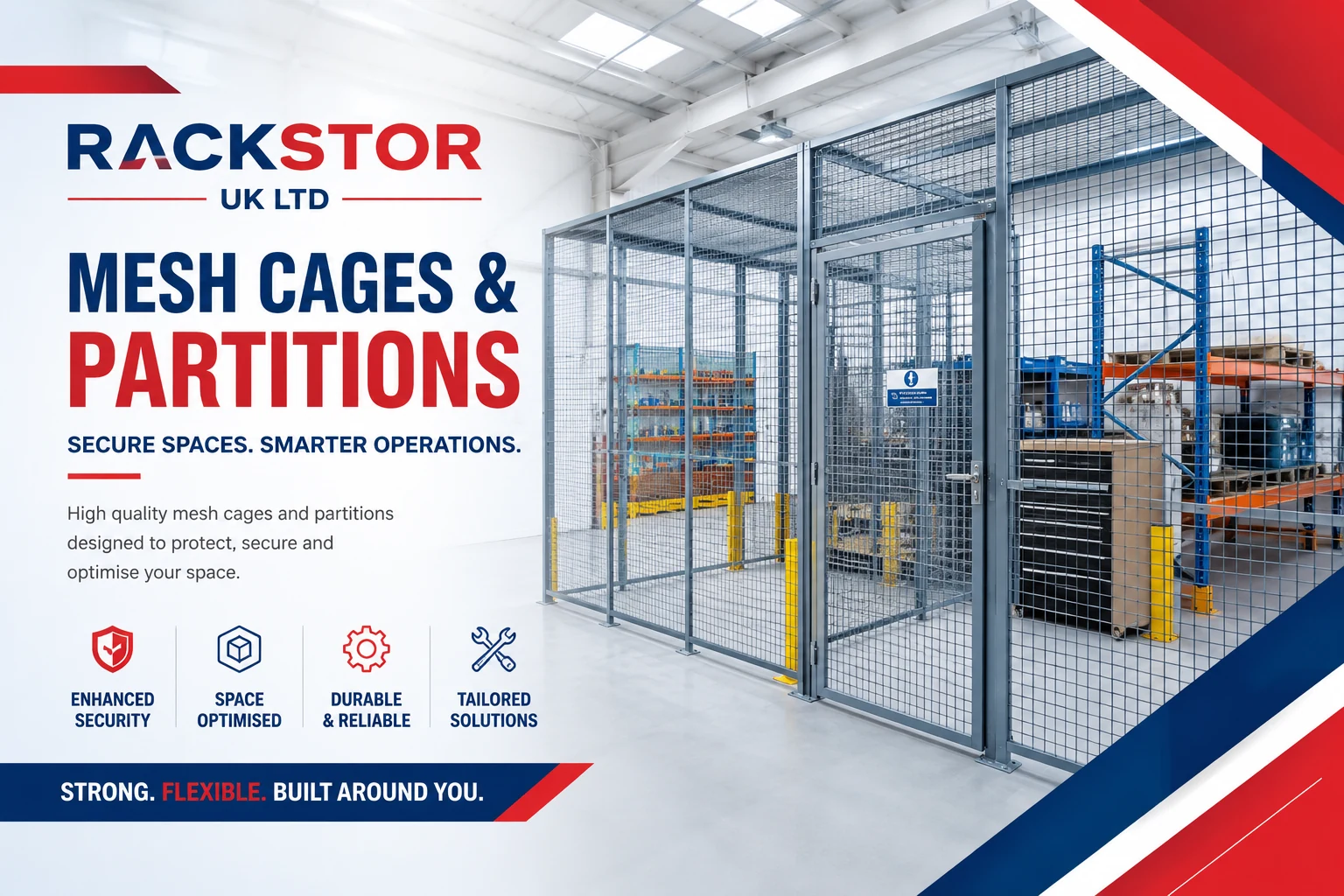
DESIGN · SUPPLY · INSTALLATION — NATIONWIDE
Machine Guarding
High-quality steel mesh machine guarding panels designed to keep people and processes safe. Configurable for robotic cells, conveyors, presses and automated production lines — compliant with EN ISO 14120 & EN ISO 14122.
Features
- Compliant with EN ISO 14120 machine safety standards
- Sliding, hinged and lift-off interlocked doors
- Cable, pipe and conveyor cut-outs to order
- Standard safety-yellow / charcoal grey two-tone finish
- Quick-release fasteners for service access
Applications
- Robotic welding and pick-and-place cells
- Conveyor and packaging line protection
- Press, lathe and CNC enclosures
- Automated warehouse and AGV zones
Specification
Regulatory Framework
In the UK, the primary regulations that require you to guard dangerous parts of machinery are the Provision and Use of Work Equipment Regulations 1998 (PUWER). Regulation 11 sets out a hierarchy of protective measures with fixed enclosing guards at the top. Machinery placed on the market must comply with the Supply of Machinery (Safety) Regulations 2008. The recognised technical standard for the design and construction of fixed and movable guards is BS EN ISO 14120, used together with BS EN ISO 13857 for safety distances (reach-through, reach-over, reach-under) and BS EN ISO 13849-1 for the safety-related parts of any interlock control system. Rackstor UK Ltd machine guarding is designed and installed against these standards, and every installation is documented with the as-installed layout and panel schedule.
Fixed vs Movable (Interlocked) Guards
A fixed guard is bolted in place and can only be removed with a tool — used where access behind the guard is only required infrequently for maintenance. A movable guard is a hinged or sliding door in the perimeter fence, used where operators need routine access into the guarded volume. Any movable guard must be interlocked with the machine's safety control system so that opening the door removes power from the dangerous parts, and closing the door alone does not restart them. Interlock switches — mechanical, magnetic-coded or non-contact RFID-coded — and the associated safety relay or safety PLC are normally provided by the machine builder or site control engineer; Rackstor UK Ltd supplies the guard structure and door hardware ready to accept them.
Reach-Through and Safety Distance
Mesh aperture and standoff distance from the hazard must be considered together. A larger aperture placed close to a moving part can allow reach-through access even though the barrier itself is present. BS EN ISO 13857 provides the tables that determine the minimum standoff for a given aperture, and Rackstor UK Ltd uses those tables to confirm the perimeter position around the machine's danger zones at survey stage. If the machine's working envelope changes later, the perimeter is re-checked against the same tables before re-configuration.
Panels, Posts and Doors
Standard panels are welded steel mesh, 50 × 200 mm aperture in 4 mm wire, in a bolted tubular or box-section steel frame. Panel heights are 1.6 m, 2.0 m and 2.4 m in 500 mm width increments up to around 2.0 m. Posts are Ω-profile or box-section steel bolted to the concrete slab. Doors are hinged single or double leaves, or sliding on floor tracks where hinged sweep is not possible. Cable, pipe and conveyor cut-outs are made to order and edged with cover strips. The standard finish is a two-tone polyester powder coat — safety yellow (RAL 1023) mesh with charcoal grey (RAL 7016) posts and doors.
Installation Process
- 01Survey of the machine layout, cell footprint, floor condition, service routes and door positions
- 02Perimeter drawn up, reach-through distances confirmed against BS EN ISO 13857, layout signed off
- 03Manufacture — panels, posts and doors made to size, cut-outs for services included
- 04On-site — floor lines set out, posts drilled to slab, panels bolted between posts, doors hung and adjusted
- 05Interlock switches fitted by the machine builder or site control engineer
- 06Handover documentation — as-installed drawing, hardware schedule and confirmation of design to BS EN ISO 14120
Frequently Asked Questions
Which standards does your machine guarding meet?
The guard structure is designed to BS EN ISO 14120 (fixed and movable guards), with safety distances taken from BS EN ISO 13857. Any interlock control system integrated into the guard is designed to BS EN ISO 13849-1. The employer's duty for the completed installation sits under PUWER 1998.
What mesh aperture is used?
The standard aperture is 50 × 200 mm in 4 mm wire — a good compromise of visibility, weight and strength. The aperture must be paired with a correct standoff distance from the hazard, taken from EN ISO 13857.
Do you supply the safety interlocks?
The guard structure, doors and door hardware are supplied and installed by Rackstor UK Ltd. Interlock switches and the safety control wiring are normally provided by the machine builder or site control engineer because they must integrate with the machine's own safety control system.
Can the guarding be reconfigured?
Yes. Panels are bolted between posts rather than welded, so bays can be removed, added or repositioned as the cell layout changes. Floor anchors can be re-drilled in a new position.
How long does installation take?
Typical lead time is two to four weeks from order. On-site installation of a robotic cell perimeter is normally completed in one to two days depending on cell size and door count.
Scoping a machine guarding project
Risk assessment first, agreeing who supplies the steel and who supplies the safety circuit, access mapping, budgeting and realistic lead times.
Read the guideRequest a quote
Free site survey. Fast turnaround. Nationwide installation.