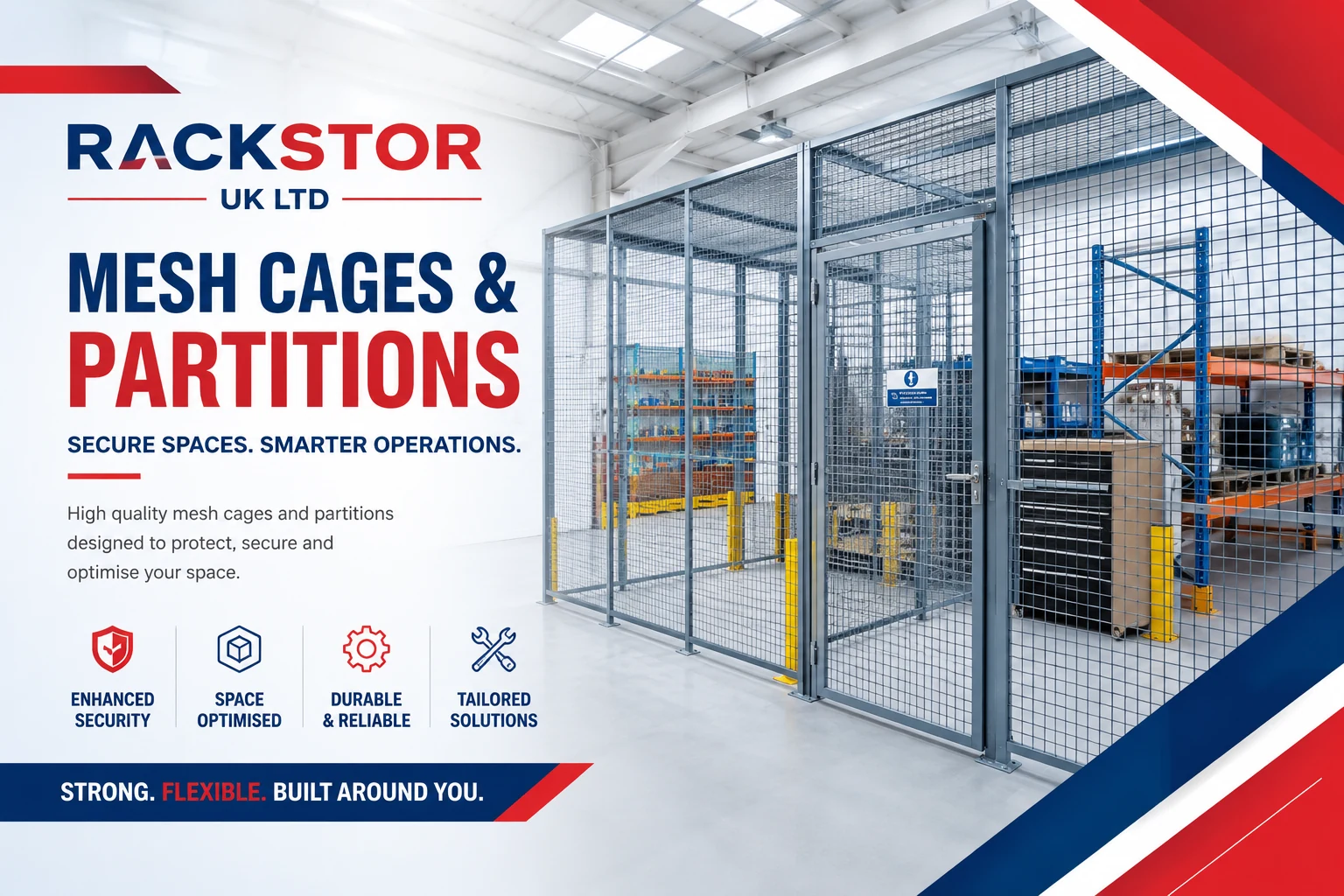
DESIGN · SUPPLY · INSTALLATION — NATIONWIDE
We make mesh. Nothing else.
Mesh-Cages is the welded mesh division of Rackstor UK Ltd. Every enquiry that comes through this site is for one of four things: single skin mesh partitioning, security cages, anti-collapse rack cladding or steel mesh machine guarding. That narrow focus is deliberate — it is what lets us hold core panel sizes in stock, keep the same detailers on every drawing, and send crews to site who have fitted the same system a hundred times before.
How a mesh panel gets made
Panels start as cold-drawn steel wire, laid into a grid and resistance-welded at every intersection so the sheet behaves as one rigid element rather than a woven cloth. The welded sheet is then cut to size and framed — rolled steel angle for partition and cage panels, tubular section where a guarding panel needs to take an impact load. Apertures of 50 × 50 mm and 50 × 100 mm cover most partitioning and caging work; guarding panels typically run a 50 × 200 mm aperture in 4 mm wire, chosen against reach distance rather than appearance.
Finishing is either hot-dip galvanising, where the framed panel is dipped after fabrication so the cut edges and weld points are coated as well as the faces, or polyester powder coating over a galvanised or primed substrate for a RAL colour. Cutting and drilling always happen before finishing, never after, so no bare steel is exposed on a delivered panel. Bespoke infill panels — the ones that go around a sprinkler drop, a fire main or a sloping soffit — are fabricated from the survey dimensions rather than trimmed on site.
Guarding compliance is a design job, not a paperwork job
Machine guarding is the part of our work with the least room for interpretation. A perimeter is only compliant if aperture and standoff distance were chosen together against the reach-through tables, if fixed panels genuinely need a tool to remove, and if every routine access point is a door that can be interlocked rather than a panel somebody will unbolt and leave off. We detail against BS EN ISO 14120 and BS EN ISO 13857, and every guarding installation leaves site with an as-installed drawing and a panel and hardware schedule for the machine file.
We are equally clear about where our scope ends. We supply and install the guard structure, doors and door hardware. Interlock switches, the safety relay or safety PLC and the wiring back into the machine stop circuit belong with the machine builder or your control engineer, and the machine-level risk assessment belongs with your responsible person. Saying that at quotation stage is what stops a finished fence standing round a machine for three weeks waiting for somebody to own the safety circuit.
Our own crews, on live sites
Mesh installation is not general site labour. Our fitters are employed, CSCS carded and work to the same detailer's drawing every time, so the person who surveyed the run is accountable for what gets fitted.
Most of our work happens around a running operation. Anti-collapse retrofits and cage installs are routinely phased out-of-hours or across weekend downtime so only the bays being worked on come out of service.
Every job is set out from survey dimensions — post positions, panel runs, door swings, cut-outs for services — and approved before fabrication starts. Nothing gets improvised with an angle grinder on site.
Talk to the mesh team
A single tool compound or a full mezzanine-level enclosure — we detail it, fabricate it and fit it.
Get in touch