DESIGN · SUPPLY · INSTALLATION — NATIONWIDE
Anti-Collapse Mesh for Racking
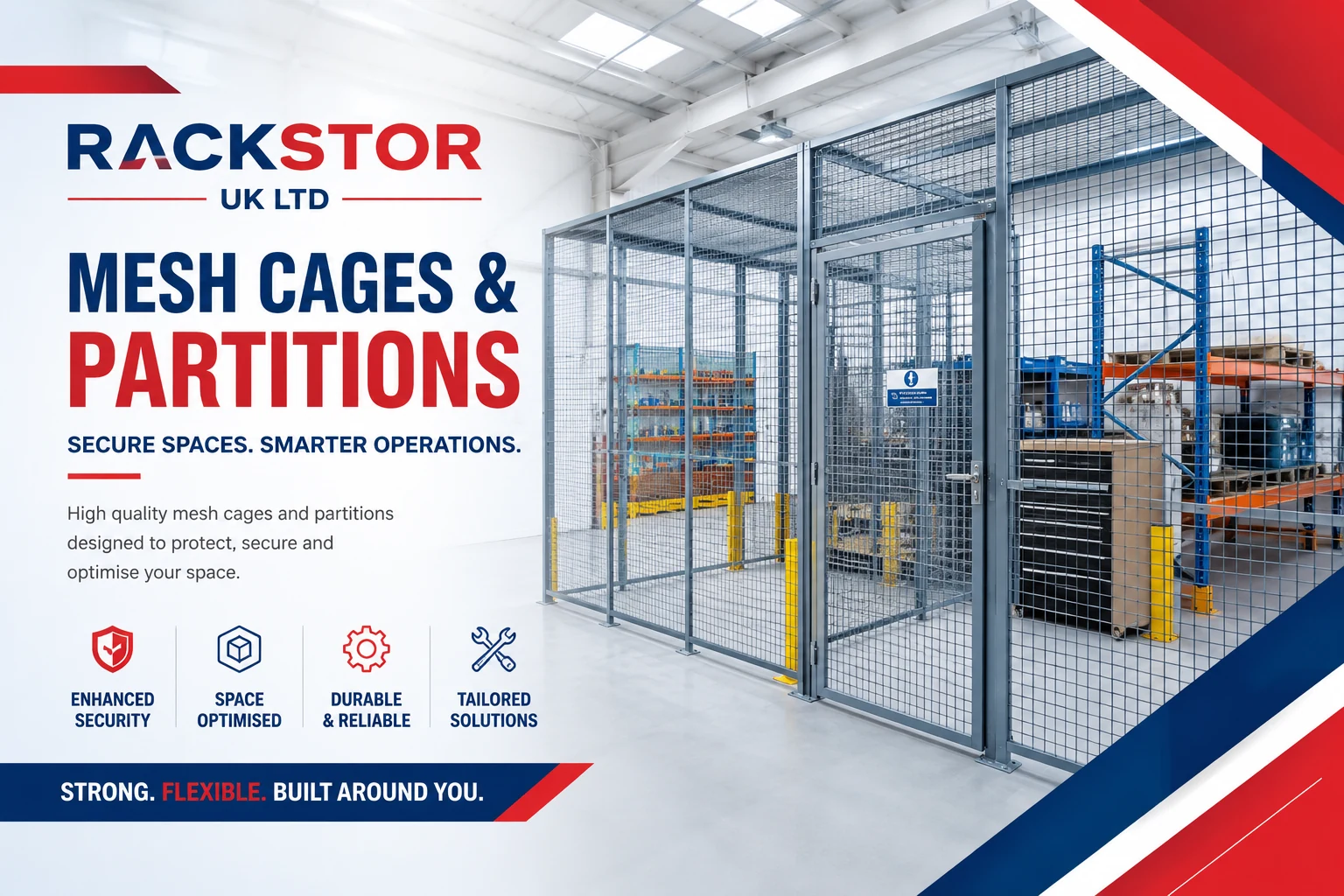
Anti-collapse mesh is fitted to the rear, sides and ends of pallet racking to stop pallets, cartons and loose stock falling into adjacent aisles, walkways or onto people. Rackstor UK Ltd supplies and installs a complete anti-collapse system — anti collapse mesh panels, universal racking brackets and, where required, matching anti-collapse mesh & partitioning around walkways and work areas — engineered to contain fallen loads and support compliance with HSE workplace safety guidance and SEMA rack inspection principles.
Features
- Welded steel anti collapse mesh panels engineered to retain fallen loads
- Universal brackets — anti-collapse mesh for racking from every major UK brand
- Rear, side and end-of-rack coverage as a single anti-collapse system
- Retrofit to existing racking without dismantling the bays
- Powder-coated finish in safety yellow (RAL 1023) or any RAL colour
- Combined anti-collapse mesh & partitioning around walkways and pick faces
Applications
- Rear of pallet racking backing on to aisles or walkways
- Side / end frames of racking at aisle ends and turning points
- Back-to-back racking runs with a shared central mesh spine
- Mezzanine edges, conveyor zones and pick-face barriers
- Cold stores, 3PL sheds and high-throughput distribution centres
Specification
What Anti-Collapse Mesh Actually Prevents
Anti collapse mesh does not stop a pallet being knocked or overpushed in the first place — that is a function of pallet condition, load stability, wrapping and forklift handling. What anti-collapse mesh for racking prevents is the secondary event: a dislodged carton, loose case or unstable pallet falling through the back or side of the racking into an aisle, walkway, workstation or public area on the other side. In HSE terms the mesh is the last line of defence in a hierarchy that starts with rack design and inspection under SEMA guidance, upright and end-frame protection, driver training and load stability, and ends with a physical barrier that contains anything the earlier controls miss.
Rear, Side and End — Where the System Goes
A complete anti-collapse system is specified from what is behind and beside each run of racking, not from the racking itself. Rear mesh is fitted to the back of any bay whose rear face is exposed to an aisle, walkway, wall-side gangway or pedestrian route. Side / end mesh is fitted to the exposed end frames at the ends of a run, especially where forklifts turn tight into the aisle and where end frames back on to a main gangway. Where two runs of racking sit spine to spine a single shared mesh spine between them catches items from either side, which is faster to fit than cladding both rears separately. Above pick faces and around walkways, anti-collapse mesh & partitioning is used to create a continuous vertical barrier that ties the racking protection into the wider warehouse partitioning.
Configurations
Rack-back mesh covers the rear face of a single run of racking. Rack-end mesh covers the exposed end frames of a run. Back-to-back protection uses a shared central mesh panel between two spine-to-spine runs. Overhead mesh is fitted above walk-through openings between runs so items cannot fall down onto pedestrians using the gap. Which combination you need is determined at survey — the same site will typically use two or three of these configurations rather than just one.
Bracket Systems and Racking Compatibility
Panels attach to the racking with universal brackets that clamp to the upright profile, so anti-collapse mesh for racking can be retrofitted to almost any existing system without dismantling the bays. The universal brackets are compatible with the profiles of the major UK racking brands including Dexion, Redirack, Link 51, Mecalux, Stow, Apex and HiLo. Where pallets deliberately overhang the rear beam, the mesh is set back off the frame on standoff brackets so pallets do not foul the mesh in normal operation. Where racking is damaged, twisted or out of tolerance the underlying racking is corrected before mesh is fitted so the panels align to a straight surface — otherwise gaps open at the panel joins and defeat the purpose of the barrier.
Standards and Duty of Care
Anti-collapse mesh is not itself the subject of a single UK product standard, but the duty to prevent falling objects is set out in the Workplace (Health, Safety and Welfare) Regulations 1992 and the Health and Safety at Work etc Act 1974. SEMA Code of Practice for the Use of Static Pallet Racking and the SEMA rack inspection guidance recommend physical containment where the rear or ends of racking are exposed to people or traffic on the other side. Rackstor UK Ltd designs the anti-collapse system around those principles — coverage where people can be struck, universal brackets that do not compromise the racking manufacturer's design, and welded panels sized so containment is continuous across each bay.
Installation Process
- 01Survey — record racking manufacturer, upright profile, upright pitch, beam pitch, pallet overhang, and every rear / side / end face that needs anti collapse mesh
- 02Design — mark up which bays get rear mesh, which get side/end mesh, and where a shared back-to-back spine is used
- 03Manufacture — panels cut and framed to the exact bay dimensions with the correct universal bracket set for the racking brand
- 04Programming — installation scheduled out-of-hours or over a weekend to avoid disrupting picking
- 05Site works — bays being clad are emptied, brackets clamped to uprights, panels lifted into place and secured, standoffs added where pallets overhang
- 06Line and coverage check — confirm no gaps between panels, no interference with normal picking and continuous coverage across the full anti-collapse system
Frequently Asked Questions
What does anti collapse mesh actually do?
Anti collapse mesh contains loads that have already been dislodged inside the racking so they cannot fall through into an aisle, walkway or work area on the other side. It is not a substitute for pallet inspection, load stability checks and safe forklift handling — it is the physical barrier that catches what those controls miss.
Where is anti-collapse mesh for racking normally installed?
The mesh is installed at the rear of any bay whose back face is exposed to an aisle or walkway, on the side / end frames of a run at aisle ends and turning points, and between back-to-back runs as a shared central spine. Above pedestrian walk-through gaps between runs, an overhead panel is added so items cannot fall onto people using the gap.
Do I need it on every bay?
Only where the rear, side or end of the racking is exposed to an aisle, walkway, workstation, pick face or public area on the other side. Bays that back on to a solid wall with no through access typically do not need it — the survey identifies exactly which faces require coverage.
Is it a full anti-collapse system or just panels?
It is a full anti-collapse system: welded mesh panels, universal brackets matched to the racking manufacturer, standoff brackets where pallets overhang, and integration with any adjacent anti-collapse mesh & partitioning around walkways and pick faces so coverage is continuous rather than bay-by-bay.
Will it fit my racking brand?
Universal brackets fit the profiles of every major UK pallet racking brand including Dexion, Redirack, Link 51, Mecalux, Stow, Apex and HiLo. The survey confirms the exact bracket type before manufacture, so the panels arrive on site ready to fit without modification.
Do I have to empty the racking to install it?
Only the specific bays being clad. Installation is scheduled out-of-hours or over a weekend so picking is not disrupted, and bays are refilled as soon as their panels are up.
Which standards and guidance does anti-collapse mesh support?
The duty to prevent falling objects sits under the Workplace (Health, Safety and Welfare) Regulations 1992 and the Health and Safety at Work etc Act 1974. SEMA guidance on the use and inspection of static pallet racking recommends physical containment where racking is exposed to people or traffic on the other side. The anti-collapse system is specified around those principles.
What colour is the mesh?
Most common is powder-coated safety yellow (RAL 1023) for high visibility. Panels can be finished in any RAL colour to match existing racking, partitioning or brand palette.
Anti-collapse mesh supports a rack inspection regime but does not replace one. SEMA-aligned racking inspections, damage assessment and inspection scheduling are handled by our sister company.
Rack Safety Inspections →Deciding where anti-collapse mesh is actually needed
How to walk your racking, prioritise the runs that create real exposure and phase a retrofit without stopping the warehouse.
Read the guideRequest a quote
Free site survey. Fast turnaround. Nationwide installation.